
The short answer
For commercial drivers, fleet owners and institutions, the useful questions are practical: What will the vehicle carry, how far will it travel, how steep is the route and where will it charge?
Begin with passenger or cargo need
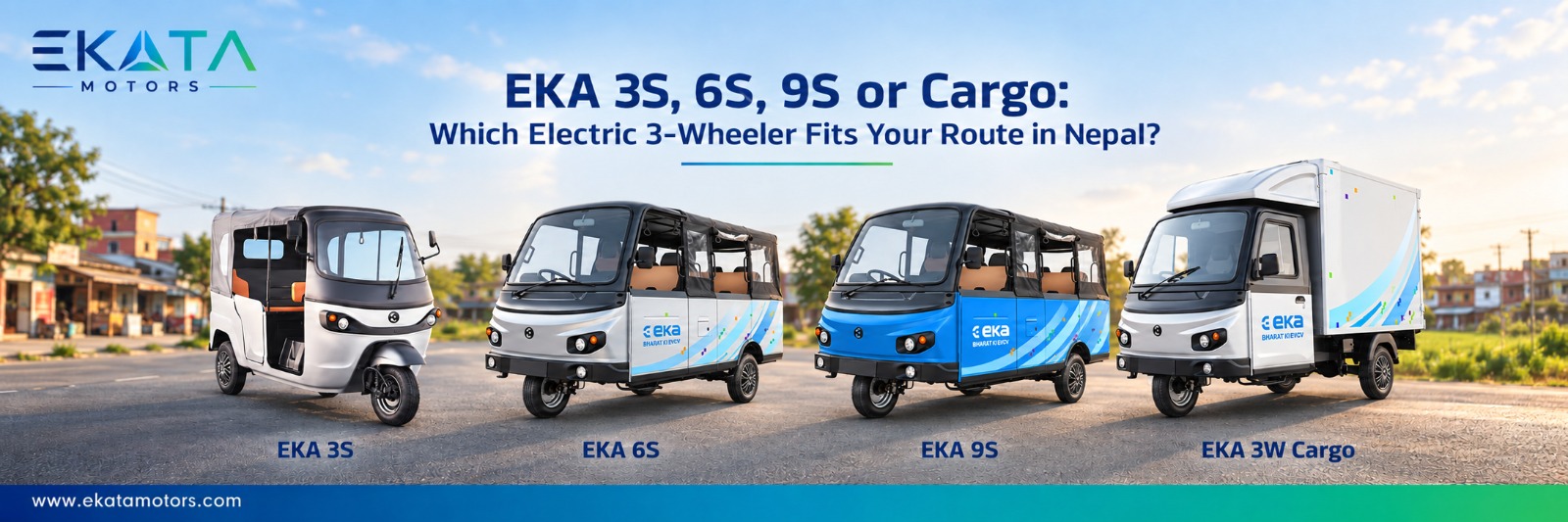
If the vehicle will carry paying passengers, employees, students, guests or community members, compare the EKA 3S, EKA 6S and EKA 9S. If the main job is moving goods, the EKA 3W Cargo is the purpose-built option.
EKA 3S for compact passenger routes
The EKA 3S seats a driver and three passengers. It is the natural starting point for short urban trips, feeder services and owner-drivers who do not need six or nine passenger seats on every run.
EKA lists a range of up to 160 km per charge, a 10.75 kWh lithium iron phosphate battery, 10 kW peak power and 21% gradeability. The listed maximum speed is 60 km/h. Its compact size and 4.5 m turning radius may help on congested roads and routes with frequent turns.
The EKA 3S is a sensible candidate when:
- Most trips carry no more than three passengers.
- Narrow roads and easy manoeuvring matter more than maximum seating.
- The vehicle can return to a reliable charging point between shifts or overnight.
Charging is listed at about 3.5 hours on single-phase AC through a 16 A socket and about two hours with the compatible DC option.
EKA 9S for predictable passenger volume
The EKA 9S seats a driver and nine passengers. It is best considered when the route or institution can use those seats regularly, rather than only during occasional peaks.
The EKA 9S shares the main published performance figures of the 6S: a 16.1 kWh LFP battery, up to 175 km of range, 10 kW peak power, 21% gradeability and a 50 km/h maximum speed. Its charging options are listed at approximately five hours on single-phase AC and two hours with compatible DC charging.
Compare average occupancy, not only the busiest trip of the week. If demand normally stays at six passengers or fewer, the EKA 6S may fit better. If seven to nine seats are filled consistently, the EKA 9S can reduce the number of trips required.
EKA 3W Cargo for last mile delivery
The EKA 3W Cargo is designed for goods movement. It has a listed payload of 750 kg and seating for a driver plus two occupants. EKA states a range of up to 200 km, a 20 kWh LFP battery, 15 kW peak power and 19% gradeability.
The cargo body provides a long deck and approximately 220 cubic feet of volume. That makes the model relevant to retail distribution, parcels, food and beverage delivery, agricultural produce, hardware and local institutional logistics.
Charging is listed at approximately 6.5 hours on single-phase AC and three hours with compatible DC fast charging. The vehicle also includes hill-hold assistance and has a stated maximum speed of 50 km/h.
Treat 750 kg as the working payload limit. Include the weight of goods, packaging, body configuration and occupants. Also check volume, because a light but bulky load can fill the body before it reaches the weight limit.
Match range to daily kilometres
Published range is useful for comparison, but it is not a guaranteed daily distance. Load, traffic, temperature, road surface, gradients and driving style all affect energy use.
Before choosing a model, record:
- The kilometres covered on a normal working day.
- The longest day expected during the week or month.
- Typical passenger or cargo load and the steepest sections of the route.
- Charging opportunities and a reserve for diversions or congestion.
Keep an operating reserve and test the route with a representative load. Stated range is up to 160 km for the EKA 3S, 175 km for the EKA 6S and EKA 9S, and 200 km for the EKA 3W Cargo. EKA notes that range depends on the application and driving cycle.
Check gradients on the actual route
The EKA 3S, EKA 6S and EKA 9S list 21% gradeability. The EKA 3W Cargo lists 19%. These are percentage gradients, not angles in degrees.
Those figures are useful for an initial comparison, but they cannot describe every road in Nepal. Surface condition, repeated climbs, vehicle load and the need to stop and restart on a slope all affect performance. For a hilly route, test the steepest section with the expected working load before placing a fleet order.
Plan charging before delivery
All four models list single-phase AC charging, which can suit overnight charging at a depot or home base. Faster DC options are also listed, but the connector, charger capacity, electrical supply and installation requirements must be confirmed for the vehicle supplied in Nepal.
Inspect the charging site and answer these questions:
- Can the electrical connection safely support the required load?
- Will several vehicles need to charge at the same time?
- Is the overnight parking window long enough for AC charging?
- Does the duty cycle genuinely require faster daytime charging?
A vehicle parked for five or six hours each night may not need fast charging. A two-shift operation may need a planned charging break, a compatible faster charger or additional vehicles.
Include after sales support in the decision
Commercial vehicles earn when they are available for work. Buyers should therefore assess service and parts support with the same care as range, seats and payload. Ekata Motors states that its Nepal support includes vehicle selection, service readiness, parts planning, training and charging guidance.
Before signing a purchase order, confirm:
- The vehicle and battery warranty for the model and configuration offered.
- The nearest authorised service point and normal maintenance intervals.
- Availability of common replacement parts.
- The process for roadside or technical assistance.
Institutions and larger fleets should agree on parts stocking, preventive maintenance and staff training before delivery.
Make the final choice
- Choose the EKA 3S if most trips carry up to three passengers and compact size is important.
- Choose the EKA 6S if the route regularly carries four to six passengers and needs flexible shared capacity.
- Choose the EKA 9S if seven to nine passenger seats will be used consistently.
- Choose the EKA 3W Cargo if the job is moving goods and the working load fits within the listed 750 kg payload.
Use the table below as a shortlist, then validate the decision on the route. Measure daily kilometres, carry a realistic load, test the steepest section and confirm charging and after-sales arrangements with Ekata Motors Nepal.
Four model comparison
Manufacturer-stated figures. Actual range and charging time vary with operating conditions and equipment.
| Criteria | EKA 3S | EKA 6S | EKA 9S | EKA 3W Cargo |
|---|---|---|---|---|
| Primary use | Passenger | Passenger | Passenger | Cargo |
| Capacity | D + 3 | D + 6 | D + 9 | D + 2 750 kg payload |
| Stated range | Up to 160 km | Up to 175 km | Up to 175 km | Up to 200 km |
| Battery | 10.75 kWh LFP | 16.1 kWh LFP | 16.1 kWh LFP | 20 kWh LFP |
| Peak power | 10 kW | 10 kW | 10 kW | 15 kW |
| Gradeability | 21% | 21% | 21% | 19% |
| Maximum speed | 60 km/h | 50 km/h | 50 km/h | 50 km/h |
| AC charging | About 3.5 h | About 5 h | About 5 h | About 6.5 h |
| DC charging | About 2 h | About 2 h | About 2 h | About 3 h |
| Best fit | Compact urban and feeder routes | Shared and institutional shuttles | High-demand passenger routes | Last-mile delivery and local distribution |
Sources & further reading
Ekata Motors Team
Vehicle information and practical guidance from the Nepal distributor team.